What Is Artificial Intelligence (AI)? A Complete Guide
Artificial Intelligence, commonly known as AI, has become one of the most important technologies of the modern world. From smartphones and search engines to healthcare systems, online shopping, banking, education, and entertainment, AI is increasingly involved in the way people live and work. Although the term may sound highly technical, the basic idea behind artificial intelligence is relatively simple: AI enables computers and machines to perform tasks that normally require human intelligence.
These tasks can include understanding language, recognizing images, learning from information, identifying patterns, making predictions, solving problems, and assisting people with decisions. Unlike traditional computer programs that simply follow a fixed set of instructions, many modern AI systems can learn from data and improve their performance over time.
Understanding Artificial Intelligence
Artificial intelligence is a branch of computer science focused on creating machines and software capable of performing intelligent activities. Human intelligence allows us to learn from experience, understand our surroundings, communicate with others, and adapt to new situations. AI attempts to reproduce some of these abilities using computers, algorithms, data, and mathematical models.
For example, when a voice assistant understands a spoken question and provides an appropriate response, AI is working behind the scenes. When an email service identifies suspicious messages as spam, artificial intelligence may be involved. Similarly, when a streaming platform recommends a movie based on someone’s previous viewing habits, an AI-powered recommendation system may be analyzing patterns in user behavior.
AI does not necessarily mean creating a machine that thinks exactly like a human. Instead, it often means designing systems that can perform specific intelligent tasks efficiently.
How Does AI Work?
Modern artificial intelligence depends heavily on data, algorithms, computing power, and mathematical models. Data provides examples from which an AI system can identify patterns. Algorithms provide methods for processing that information, while computing resources allow complex calculations to be performed quickly.
One of the most important approaches used in AI is machine learning. In machine learning, a system is trained using data rather than being programmed with every possible instruction.
Imagine teaching a computer to recognize pictures of cats. Instead of writing a separate rule for every possible cat, developers can provide the system with a large collection of labeled images. During training, the model analyzes visual patterns and gradually learns characteristics associated with cats. Once trained, it can examine a new image and estimate whether it contains a cat.
The quality of an AI system depends on many factors, including the amount and quality of training data, the design of the model, the training process, and how the system is evaluated.
Major Types of Artificial Intelligence
AI can be classified in different ways. One common classification is based on the capabilities of the system.
1. Narrow AI
Narrow AI, also called weak AI, is designed to perform particular tasks. Most AI applications available today fall into this category.
Examples include recommendation engines, speech recognition systems, fraud detection tools, translation software, image recognition applications, and navigation systems.
A narrow AI system can be extremely powerful within its specific area, but it does not automatically possess general human intelligence.
2. General AI
Artificial General Intelligence (AGI) refers to a hypothetical form of AI capable of performing a wide range of intellectual tasks at a level comparable to humans. An AGI system would theoretically be able to learn, reason, adapt, and transfer knowledge between different types of problems.
General AI remains an active research goal rather than an established everyday technology. Current AI systems can perform impressive tasks, but that does not mean they possess the complete and flexible intelligence of a human being.
3. Superintelligent AI
The concept of superintelligent AI describes a hypothetical system whose intellectual abilities would surpass those of humans across a broad range of areas. It is primarily discussed in research, philosophy, technology policy, and future-oriented debates.
Because such systems do not currently exist, discussions about them involve significant uncertainty and speculation.
Machine Learning and Deep Learning
Machine learning is one of the foundations of modern AI. It allows computers to discover patterns in data and use those patterns to make predictions or decisions.
There are several approaches to machine learning. Supervised learning uses labeled examples, while unsupervised learning looks for patterns in data without predefined labels. Reinforcement learning involves an agent learning through interaction with an environment and receiving rewards or penalties based on its actions.
Another important technology is deep learning. Deep learning uses artificial neural networks containing many layers of computational operations. These networks can process complex forms of information, including images, audio, text, and video.
Deep learning has contributed significantly to advances in computer vision, speech recognition, natural language processing, and generative AI.
What Is Generative AI?
One of the most visible developments in recent years is generative AI. Unlike systems designed only to classify or predict information, generative AI can create new content based on patterns learned during training.
Depending on the system, generated content may include text, images, audio, video, computer code, or other forms of digital material.
For example, a generative AI assistant can help someone brainstorm ideas, explain a difficult concept, summarize information, draft an article, or create a piece of computer code. Image-generation systems can produce visual artwork from written descriptions.
Generative AI does not simply operate like a traditional search engine. It uses trained models to generate outputs based on the instructions and context it receives. However, generated information can sometimes contain mistakes, so users should evaluate important outputs carefully.
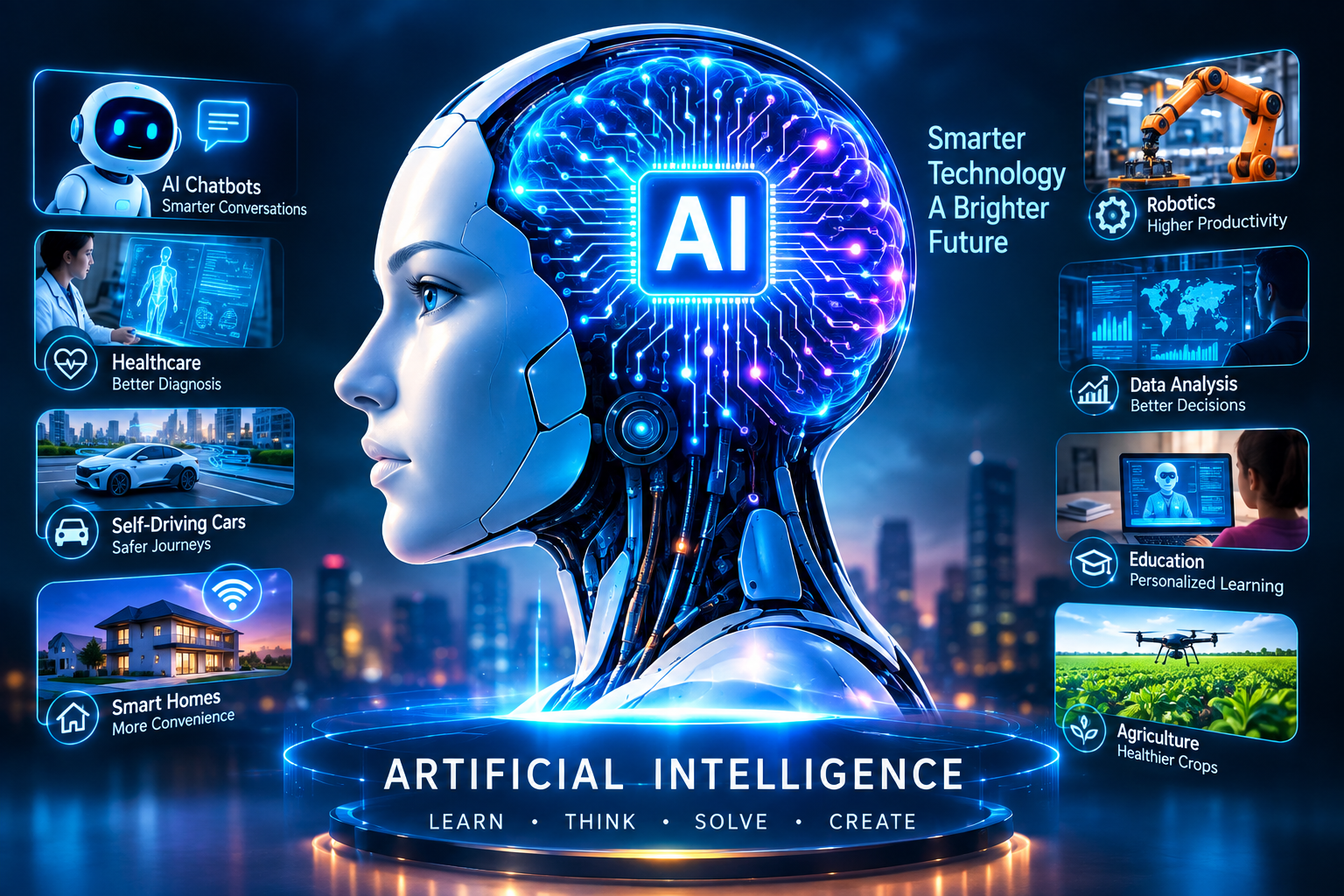
Applications of AI in Everyday Life
Artificial intelligence is no longer limited to research laboratories. It is increasingly integrated into everyday products and services.
Healthcare
AI can help healthcare professionals analyze medical images, organize information, identify patterns, support research, and improve administrative processes. Researchers are also exploring AI for drug discovery and personalized treatment planning.
AI is not a replacement for qualified medical professionals, but it can serve as a powerful supporting technology when appropriately designed and supervised.
Education
AI can provide personalized learning experiences, explain educational concepts, generate practice questions, assist teachers with administrative work, and help students explore subjects from different perspectives.
Used responsibly, AI can make educational resources more accessible and adaptable to individual learning needs.
Business
Businesses use AI for customer service, forecasting, marketing analysis, fraud detection, document processing, quality control, and workflow automation.
AI-powered chatbots can answer common customer questions, while analytical systems can examine large datasets and identify trends that may be difficult to detect manually.
Transportation
AI is used in navigation, traffic prediction, logistics, vehicle safety systems, and transportation planning. Modern vehicles may use intelligent systems to detect obstacles, recognize road conditions, and provide driving assistance.
Finance
Banks and financial institutions use AI-related technologies to detect unusual transactions, assess certain risks, automate customer support, and analyze financial information.
Fraud detection is a particularly useful application because computers can examine enormous numbers of transactions and flag patterns that may require further investigation.
Entertainment
Streaming platforms, gaming companies, social networks, and other entertainment services use algorithms to personalize recommendations. AI can also assist with content creation, visual effects, music production, game development, and editing.
Benefits of Artificial Intelligence
AI offers several important advantages.
Automation is one of its biggest benefits. Repetitive tasks can often be handled by software, allowing people to concentrate on activities requiring judgment, creativity, communication, and strategic thinking.
AI can also process enormous quantities of information quickly. This can help organizations identify trends, detect unusual activity, and make data-informed decisions.
Another advantage is availability. Software systems can operate continuously without needing traditional working hours. AI can also provide assistance to people in different languages and through different interfaces.
AI may further improve accessibility. Speech recognition, text-to-speech technology, computer vision, and intelligent interfaces can help people interact with digital systems in new ways.
Challenges and Risks of AI
Despite its advantages, artificial intelligence also creates important challenges.
One major concern is accuracy. AI systems can make incorrect predictions or generate false information. A confident-looking answer is not necessarily a correct answer.
Another issue is bias. AI models learn from data, and data can contain human biases or historical inequalities. If these problems are not identified and addressed, an AI system may produce unfair results.
Privacy is another significant concern. AI applications can process large quantities of information, including potentially sensitive data. Organizations therefore need strong policies and technical safeguards for responsible data handling.
There are also concerns about employment. Automation may change the nature of certain jobs and reduce demand for some repetitive tasks. At the same time, AI can create new occupations and increase demand for skills involving technology, analysis, creativity, management, and human interaction.
Cybersecurity, misinformation, intellectual property, transparency, and accountability are additional areas that require careful attention.
AI and the Future of Work
Artificial intelligence is likely to change many professions rather than simply eliminate all human employment. In numerous workplaces, the most practical model may be human-AI collaboration.
For example, an employee might use AI to analyze a large document, generate an initial draft, organize information, or identify possible patterns. The human can then review the result, correct mistakes, apply professional judgment, and make the final decision.
This makes digital literacy increasingly important. People do not necessarily need to become AI researchers, but understanding how AI works, what it can do, and where it can fail can become an important professional skill.
Responsible Use of Artificial Intelligence
The future value of AI depends not only on technological progress but also on responsible implementation.
Developers and organizations should consider accuracy, fairness, privacy, security, transparency, and human oversight when deploying AI systems. Users should also understand that AI-generated content may require verification.
Human judgment remains especially important when AI is used in high-impact areas such as healthcare, employment, finance, education, and public services.
Responsible AI means treating the technology as a powerful tool rather than assuming it is automatically correct or unbiased.
Conclusion
Artificial intelligence is a transformative technology that allows computers and machines to perform tasks associated with human intelligence. Through machine learning, deep learning, natural language processing, computer vision, and generative models, AI can analyze information, recognize patterns, produce content, make predictions, and assist people with a wide variety of tasks.
Its applications range from healthcare and education to finance, transportation, business, entertainment, and everyday digital services. AI can improve efficiency, automate repetitive work, process large amounts of information, and create new possibilities for individuals and organizations.
At the same time, AI brings genuine challenges involving accuracy, bias, privacy, security, employment, and responsible decision-making. Understanding these limitations is just as important as understanding the technology’s capabilities.
Ultimately, artificial intelligence should not be viewed simply as a replacement for human intelligence. Its greatest potential may come from combining machine capabilities with human creativity, judgment, empathy, and experience. As AI continues to develop, the people and organizations that learn to use it thoughtfully and responsibly will be better prepared for an increasingly intelligent digital world.